The 5 Best Portable Air Conditioners of 2026 (Tested and Reviewed)
From the whisper-quiet Midea Duo to budget-friendly Black+Decker, these are the portable ACs actually worth buying in 2026.
If you're searching for the best portable air conditioner 2026, you're probably in one of two situations: (1) your apartment building still thinks "central air" is a personality trait, or (2) you own a perfectly good home… except for that one room that turns into a toaster oven every July.
Portable ACs aren't as efficient as a proper window unit, but they can absolutely save your summer — especially if you pick a model with the right hose setup, sane noise levels, and enough real-world cooling power (hint: you want to care about SACC, not just the big flashy BTU number). The portable AC market has gotten genuinely better over the past couple of years, with inverter compressors and dual-hose designs finally trickling down from the "premium only" tier into something approaching normal-human pricing.
I pulled together the current "usual suspects" from top testing outlets and manufacturer specs, then translated them into normal-human language. Here are the portable air conditioners I'd actually consider buying in 2026 — and the ones I'd only recommend if you're on a tight budget.
Our Top Picks
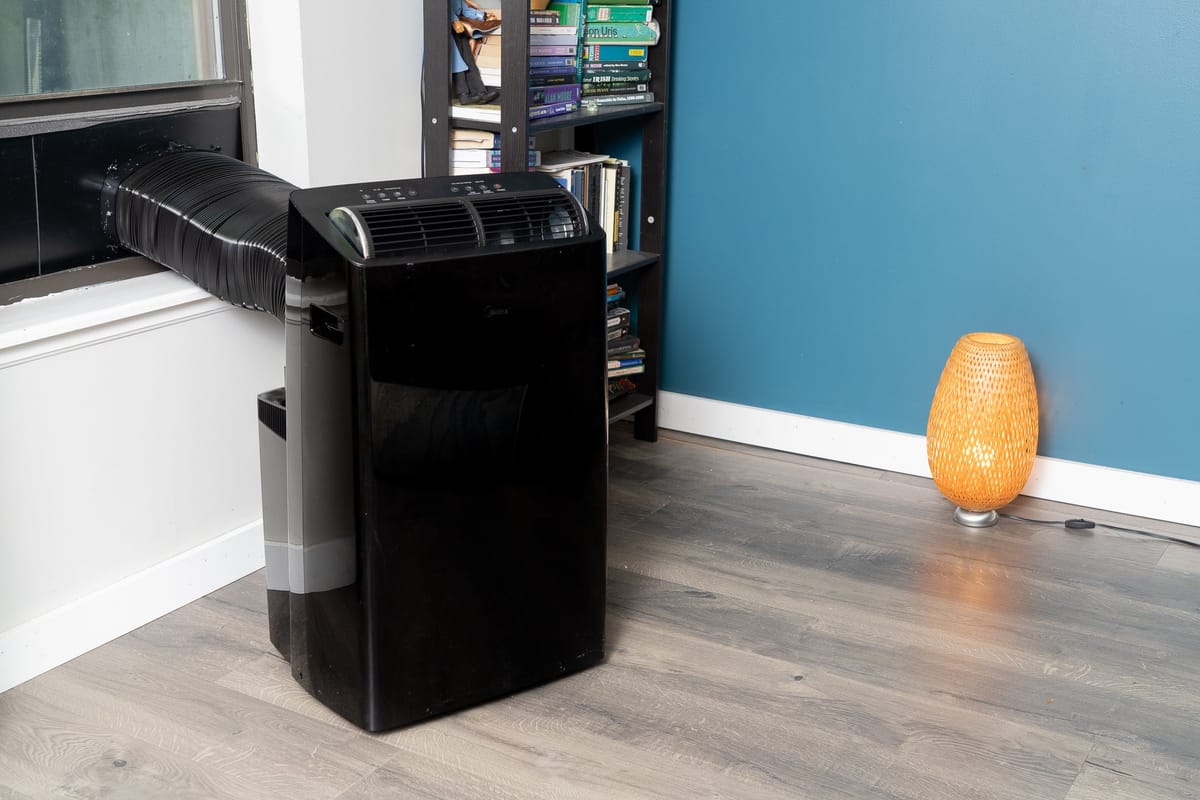
Midea Duo MAP14HS1TBL — Best overall (quiet + dual-hose + heat)
Wirecutter's current top pick is the Midea Duo MAP14HS1TBL, and it's not a subtle endorsement — they call it "more powerful, more efficient, and quieter than any other portable air conditioner we've tested," largely thanks to its inverter compressor and "hose-in-hose" dual-hose design.
In plain terms: most portable ACs are single-hose machines that accidentally pull hot air into your room while trying to cool it. The Midea Duo's dual-hose approach helps avoid that annoying negative-pressure effect, so it tends to cool faster and feel less "why is this still sweaty?" You'll notice the difference most in mid-size rooms — about 250 to 450 square feet — where the dual-hose advantage really starts to show.
It also has a heater mode (rare and genuinely useful in shoulder seasons), plus app control via Wi-Fi for scheduling and temperature tweaks from the couch. The inverter compressor is the real star here, though — instead of cycling on and off at full blast like traditional units, it ramps up and down smoothly, which means less noise and more consistent temperatures.
Downsides: It's not cheap (street prices hover around $550–$700 depending on the retailer), it tips the scales at roughly 80 pounds, and the hose-in-hose setup can be a little awkward to route compared to simpler single-hose units. Installation takes a solid 20–30 minutes the first time.
Most people who want one portable unit that's legitimately strong, relatively quiet, and usable beyond just peak summer. If you only buy one portable AC and want the best all-around pick, this is it.
Midea Duo MAP12S1TBL — Best dual-hose value (no heat, still excellent)
If you like the idea of the Midea Duo but don't care about heat, the MAP12S1TBL is Wirecutter's runner-up: similar concept, similar quiet operation, and typically a little less money. It uses the same inverter-compressor technology and hose-in-hose design, so you're getting the efficiency advantages of the top pick without paying the heat-pump premium.
Think of it as the "still fancy, slightly less extra" Duo. You're trading some cooling power (it's rated for slightly smaller rooms, around 200–350 square feet) and the heater for a lower price and a bit less weight. If your use case is strictly "make this room cold from May through September," that tradeoff makes a lot of sense.
Downsides: No heat mode, a bit less cooling muscle than its bigger sibling, and you're still dealing with the same bulky hose-in-hose setup. If you need year-round climate control from a single unit, spend up for the MAP14.
People who want a best dual-hose portable air conditioner option without paying top-pick pricing — especially if heating isn't a concern.
Black+Decker BPACT14WT — Best budget-ish big-room cooler
Wirecutter's budget pick is the Black+Decker BPACT14WT, mostly because it can cool well without demanding luxury pricing. TechGearLab's testing backs up the "it cools" part — they found it dropped the room temperature by about 8.3°F in an hour in their cooling test, which is respectable for a single-hose unit in this price range.
This is a classic single-hose unit, which means it's inherently less efficient than dual-hose designs, and it can feel a little "plasticky." But if your primary requirement is cold air on a budget, it's a sensible compromise. It has three fan speeds, a 24-hour timer, and a pretty straightforward control panel — nothing fancy, but everything you actually need. The window kit fits standard double-hung and sliding windows without much drama.
If you're in a humid climate, the auto-evaporation feature is a nice bonus — it uses the moisture it collects to help cool the condenser, so you don't have to empty a water tank as often (or at all, in most conditions).
Downsides: Single-hose efficiency penalties, noticeably higher power consumption than the Midea Duo models, and build quality that feels more "fine" than "fancy." It's also louder than the inverter competition — expect around 52–55 dB on high.
Renters or dorm-like situations where you want decent cooling performance for less cash, and you're okay with higher running costs. Also great as a secondary unit for a guest room or home office.
Whynter ARC-1230WN (NEX) — Best for efficiency-nerds who want dual-hose
If you want a more classic dual-hose approach (and you don't care about a heater), RTINGS ranks the Whynter NEX ARC-1230WN as its top portable AC pick and rates it especially well for noise and overall performance. Unlike the Midea Duo's hose-in-hose approach, the Whynter uses two separate hoses — one intake, one exhaust — which some users find easier to manage.
This is the kind of unit that appeals to people who have read one too many threads about negative pressure and now can't unsee it. The build quality feels a step above most portable ACs — the casing is sturdier, the controls are responsive, and it generally gives off "I was engineered by people who care" vibes rather than "I was designed by a marketing department." It also handles humidity well, which matters if you're running it in a basement or a particularly muggy apartment.
Downsides: Pricing can swing a lot depending on season and retailer, and it's still a bulky appliance you have to store for half the year. The two separate hoses also take up more window space than the Midea's single combined hose.
Anyone prioritizing dual-hose performance and a more "measured" testing approach over extra smart-home features. If you like RTINGS-style data-driven reviews, this is the one they'd point you toward.
Dreo AC515S / AC516S — Best for smart features (and modern design)
Dreo has become the "new kid" portable-AC brand that keeps showing up in modern-home recommendations, especially if you care about app controls, scheduling, and generally not having something that looks like a 2009 office printer in your living room. The design is genuinely sleeker than most portable ACs — more "minimalist air purifier" than "industrial cooling box."
Popular Mechanics calls one Dreo option the best bang for your buck in their testing roundup, noting strong cooling for the price and solid remote/app control. It works with both Alexa and Google Home, so you can voice-control it without getting off the couch — which, in peak August, is the kind of laziness I fully endorse. The Dreo app also tracks energy usage, which is a nice touch if you're trying to keep your electricity bill from spiraling.
One thing to note: Dreo's model numbering can be confusing (AC515S vs. AC516S vs. older models), so make sure you're looking at the right year's version. The AC516S is the newer, slightly more powerful variant.
Downsides: Single-hose design means less efficiency than the dual-hose picks above. Model naming is confusing, and you'll want to double-check the window kit fit for your specific window type — some users report the included kit doesn't work great with casement windows.
People who want a slicker-looking unit with strong smart controls, and are willing to trade a little efficiency for convenience and aesthetics.
Byteblip
New Products, Gift Guides, The Best Deals