The 5 Best Home Air Quality Monitors of 2026, Tested and Compared
Five air quality monitors that actually deliver reliable readings - from the $35 IKEA VINDSTYRKA to the sensor-packed Qingping Gen 2.
Looking for the best home air quality monitor in 2026? You're probably wondering what's actually floating around in the air you breathe every day — and whether that vaguely stuffy feeling in your living room is "normal" or a sign that something's off. Spoiler: it's often worse than you think, especially if you cook with gas, have pets, or live near a busy road.
An indoor air quality monitor won't fix your air on its own, but it tells you exactly what's happening so you can take action — open a window, run a purifier, or at the very least stop blaming your allergies entirely on pollen. The category has gotten way better in the last couple of years, with sensors that used to cost hundreds now available for under $100, and accuracy that actually rivals professional-grade equipment.
I dug through testing data from HouseFresh, Air Purifier First, Wirecutter, and plenty of Reddit threads to find the monitors that deliver reliable readings without the usual consumer-electronics disappointment. Here are five I'd actually put in my own home.
Our Top Picks
Qingping Air Quality Monitor Gen 2 — Best overall multi-sensor
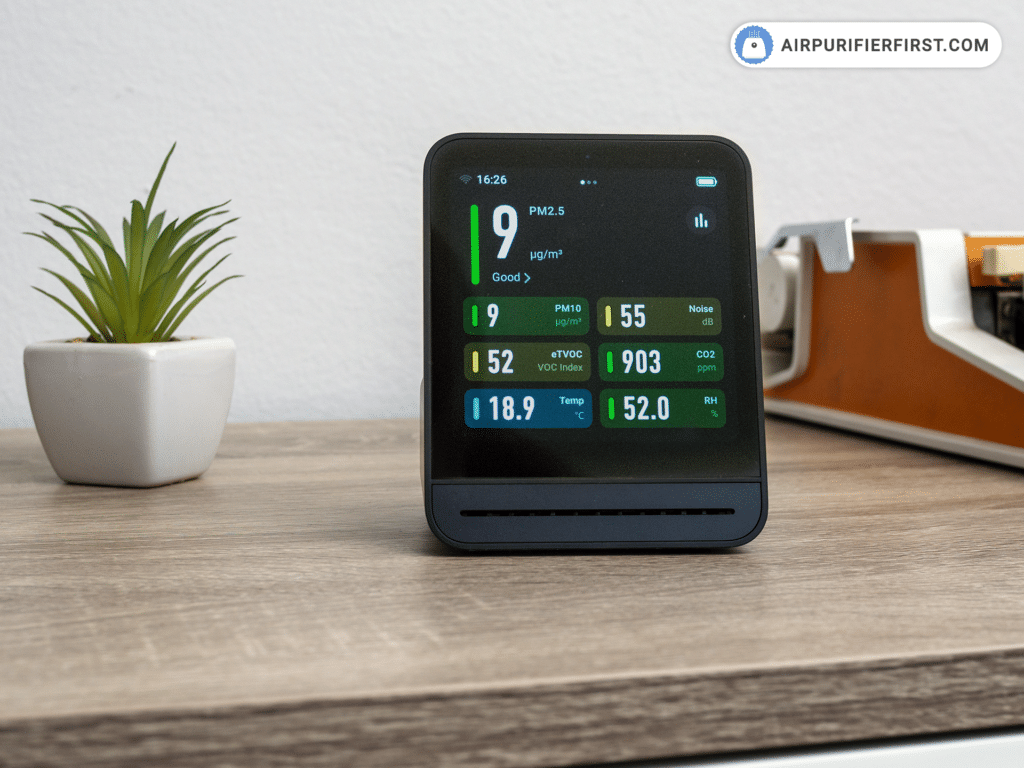
The Qingping Gen 2 is the monitor I'd recommend to most people, and it's the one that keeps winning roundups from Air Purifier First, Breathe Safe Air, and The RoboVerse. It measures seven data points — PM2.5, PM10, CO2, eTVOC, temperature, humidity, and noise level — which gives you the most complete picture of your indoor environment at this price.
The sensor hardware is genuinely impressive for a consumer device: a GrandWay laser-based particle sensor for PM2.5/PM10, a Sensirion SCD40 for CO2, and a Sensirion SGP40 for VOCs. In independent testing, its CO2 readings track within about 30 ppm of an Aranet4 (the gold standard), and the PM2.5 accuracy is rated at ±10 μg/m³. That's real precision, not just marketing numbers.
The 4-inch screen is large enough to read from across a room, and a clever upgrade over the original: the PM sensor comes as a replaceable cartridge, so when it eventually degrades (all laser sensors do after a few years), you swap the cartridge instead of replacing the whole unit. It connects to both the Qingping+ app and the Mi Home app, which makes it easy to integrate into smart home setups or just check your air quality from your phone.
Downsides: Battery life is only about 4 hours, so it's really a plug-in device with USB-C — not a portable monitor you carry room to room. The app interface is functional but not beautiful. No radon detection.
Anyone who wants the most comprehensive indoor air quality monitor without spending $200+. Ideal for tracking PM2.5 from cooking or wildfire smoke, CO2 in bedrooms, and VOCs from paint or cleaning products.
Aranet4 Home — Best dedicated CO2 monitor
If CO2 is your primary concern — and it should be if you care about focus, sleep quality, or just knowing when a room is poorly ventilated — the Aranet4 Home is the one to get. HouseFresh calls it "the best portable CO2 sensor on the market," and it's the reference device that reviewers use to test other monitors against.
What makes it special is the NDIR (non-dispersive infrared) sensor, which is more accurate and more durable than the cheaper photoacoustic sensors used in most competitors. The real kicker is the battery life: the Aranet4 runs for years on two AA batteries, not hours. That's because it has an e-ink display and doesn't try to measure everything — it focuses on CO2, temperature, humidity, and atmospheric pressure, and it does those four things exceptionally well.
It's small enough to toss in a bag and take to the office, a classroom, or a restaurant (if you're that person — no judgment). The Bluetooth app logs historical data and can alert you when CO2 levels cross a threshold, which is genuinely useful for knowing when to crack a window in a meeting room.
Downsides: No PM2.5 or VOC monitoring at all — this is strictly a CO2 and climate sensor. At $200+, it's expensive for what it measures. The e-ink display is low-refresh and basic. If you want a "see everything" monitor, this isn't it.
People who care specifically about CO2 levels and ventilation quality — remote workers, parents of young kids, anyone who sleeps in a poorly ventilated bedroom. The battery life alone makes it worth the premium if portability matters to you.
IKEA VINDSTYRKA — Best budget air quality monitor
The IKEA VINDSTYRKA is the "wait, this actually works?" entry in the air quality monitor space. At around $35, you'd expect a glorified thermometer, but IKEA somehow packed in a Sensirion SEN54 sensor — the same sensor family used in monitors costing three times as much — and it measures PM2.5, TVOCs, temperature, and humidity with surprisingly decent accuracy.
Air Purifier First's testing found its PM2.5 accuracy at around ±10%, which is comparable to monitors in the $100+ range. The display is simple and color-coded (green/yellow/red), which honestly might be all most people need — you don't always want a wall of numbers, you just want to know "is my air good or bad right now?"
The VINDSTYRKA also connects via Zigbee, which means it plays nicely with IKEA's own smart home hub and can trigger the STARKVIND air purifier automatically. If you're already in the IKEA smart home ecosystem (or use Home Assistant), this integration is genuinely useful. If you're looking for a good companion to an air purifier, our compact dehumidifier picks pair well with the VINDSTYRKA to keep your whole indoor climate in check.
Downsides: No CO2 monitoring (a big gap if ventilation is your concern). USB-C powered but doesn't include a power adapter. The Zigbee connectivity means you need an IKEA hub to unlock smart features — Wi-Fi or Bluetooth would've been more universal. No app without the hub.
Budget-conscious shoppers who want a reliable indoor air quality monitor for PM2.5 and VOCs without spending more than the cost of a decent lunch. Especially good for IKEA smart home users.
Qingping Lite — Best portable air quality monitor
If you want something you can actually pick up and carry from room to room — or toss in your bag to check your office or hotel room — the Qingping Lite is the one. Air Purifier First calls it "the best portable air quality monitor I have tested," and the combination of battery power, compact size, and multi-sensor capability makes a strong case.
It measures PM2.5, PM10, CO2, temperature, and humidity using a GrandWay particle sensor and a SenseAir S8 CO2 sensor. Battery life tops out around 7 hours, which is enough for a full workday of spot-checking different rooms. A touch slider on the top lets you flip between different data screens, and the small OLED display is sharp enough to read easily.
Like the Gen 2, it connects to the Qingping+ and Mi Home apps, so you still get data logging and smart home integration. Think of it as the Gen 2's smaller, more portable sibling — you trade the larger screen, VOC monitoring, and noise detection for a device that actually runs on battery.
Downsides: No VOC/TVOC monitoring (the Gen 2 has this, the Lite doesn't). Battery life of 7 hours sounds okay until you compare it to the Aranet4's years-long runtime. CO2 accuracy (±15%) isn't as tight as the Aranet4 or Gen 2. The small display can be hard to read across a room.
People who want a portable, battery-powered monitor they can move between rooms or take to work. Great as a second monitor to complement a plugged-in unit like the Gen 2.
AirGradient One — Best for data enthusiasts and open-source fans
Wirecutter's top pick is the AirGradient One, and it's easy to see why if you're the kind of person who wants all the data, all the time. It monitors CO2, TVOCs, NOx (nitrogen oxides — rare in consumer monitors), and PM1/PM2.5/PM10. The NOx measurement is genuinely unique and useful if you live near traffic or have a gas stove.
What sets AirGradient apart from the competition is their open-source approach — the firmware is open, the API is accessible, and you can build custom dashboards or integrate it with Home Assistant without any proprietary lock-in. Their web dashboard is also clean and information-dense without being overwhelming, which is harder to pull off than it sounds.
The physical display is easy to read, and the build quality feels thoughtful — this is clearly designed by engineers who actually use air quality monitors, not a marketing team. It's also made in a small batch approach, which means availability can be spotty, but quality control is above average. If you've been reading this article and thinking "I want the most sensors possible and I want full control over my data," this is your monitor.
Downsides: Pricier than the Qingping Gen 2 while being slightly less polished in terms of app experience. The open-source angle is a feature for some and irrelevant for others. No battery — strictly plug-in. Availability can be inconsistent.
Data nerds, Home Assistant users, and anyone who wants NOx monitoring alongside the standard PM2.5/CO2/VOC suite. If you care about open-source hardware and maximum transparency, AirGradient is the monitor that respects that.
Byteblip
New Products, Gift Guides, The Best Deals